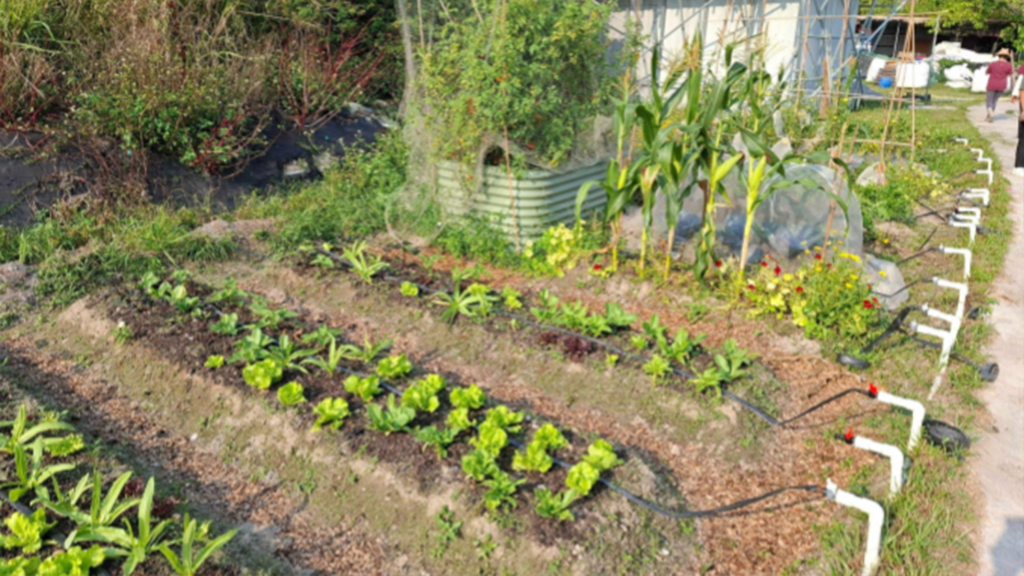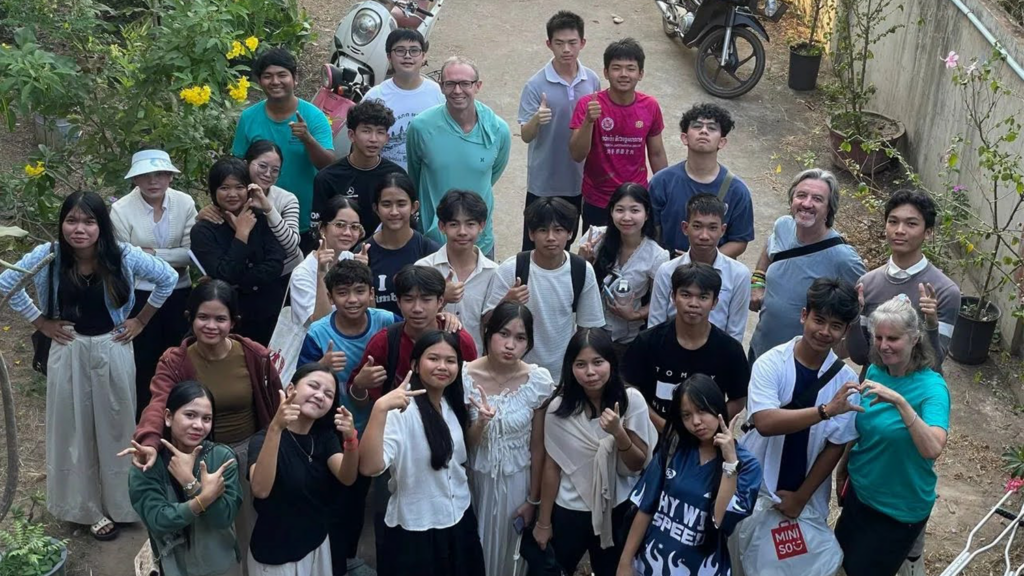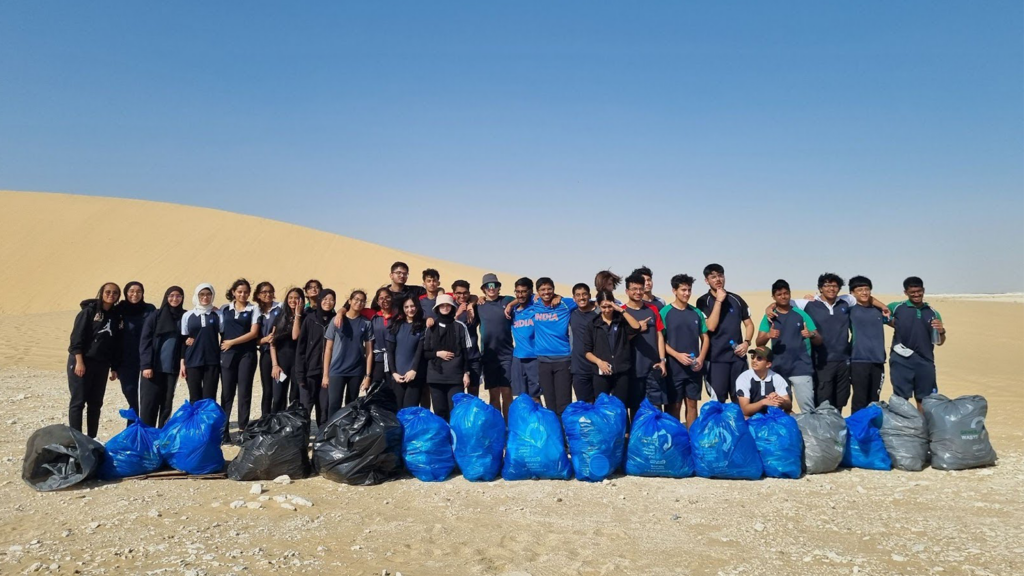
The project described in this article is the first that AUPP Liger Leadership Academy students have worked on since they completed the Grade 9 Social Science curriculum, which is built on Be the Change. While Liger students have extensive project-based learning experience, the BTC program helped them engage with the ideas of a service project in a more meaningful, impactful, reciprocal way.
What happens when you give students an opportunity to find their own
problem in the world and enough freedom to do something about it?
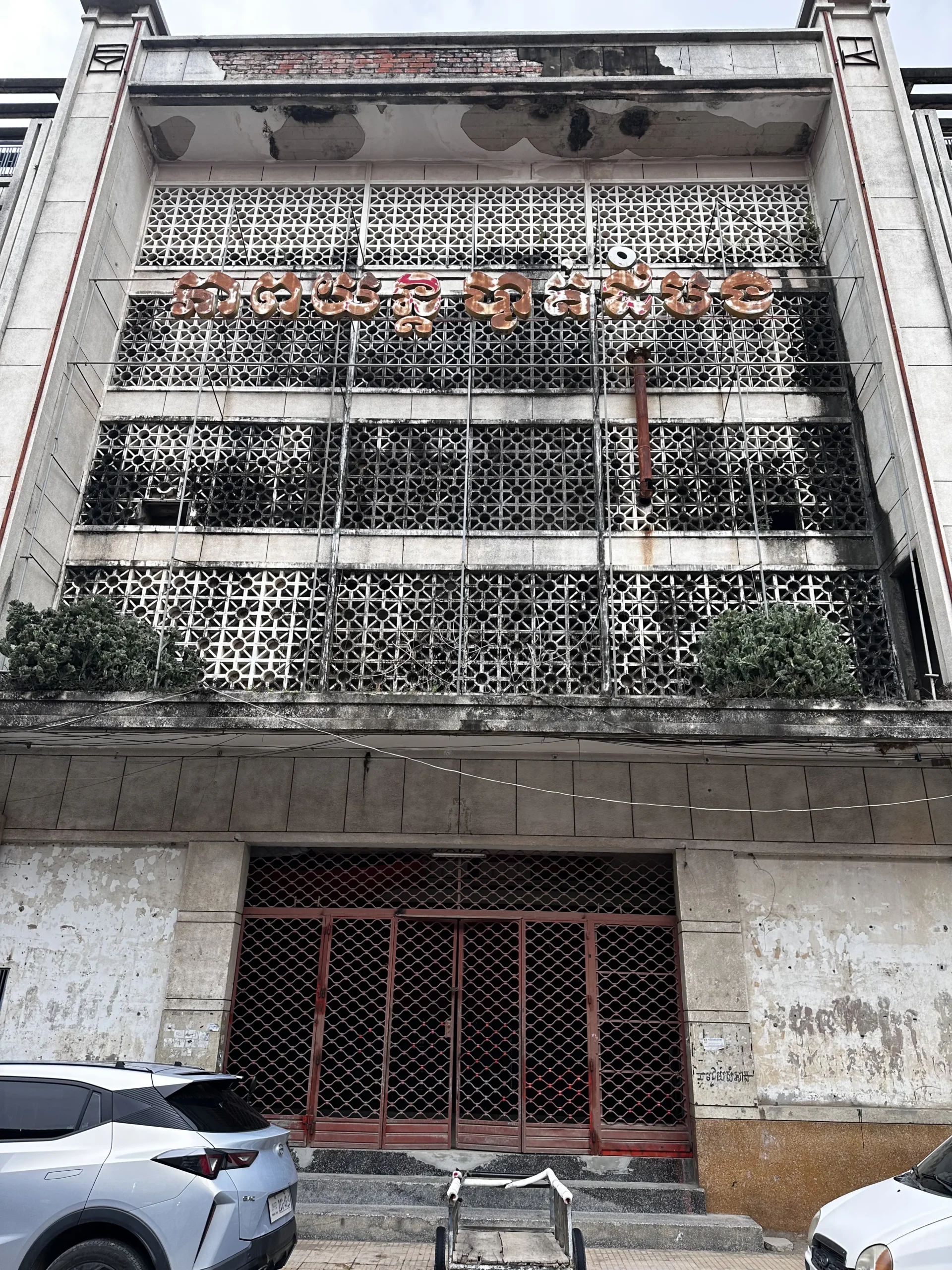
We had been standing outside Battambang’s abandoned cinema,
desperate to enter, though with little hope we’d be allowed access. After
all, the only footage we had seen of the inside was a recent visit by
Angelina Jolie. We were only in town for a few days. Surely there would be
too much official paperwork and bureaucratic red tape for a group of 14
AUPP Liger Leadership Academy 10th graders to visit as part of a school
project.
Well, we are Liger. We certainly weren’t going to give up hope.
Liger is an experiential project-based learning school. Students study our “Essential” classes - science, math, Khmer and English - while also getting to spend two hours of each day in Grade 8 and 10 doing Explorations, nine-week, project-based learning modules focused on investigating complex, real-world issues and proposing possible solutions through collaboration, communication, networking, and using the world as a classroom.
From Student Idea to Essential Questions
One of our social science-themed Explorations this year, Historical Buildings in Battambang, came directly from the
students themselves. They proposed this to our Education Director, Caroline Bell, last year as Grade 9 students, and it was
added to our schedule as a Round One Exploration when they started Grade 10.
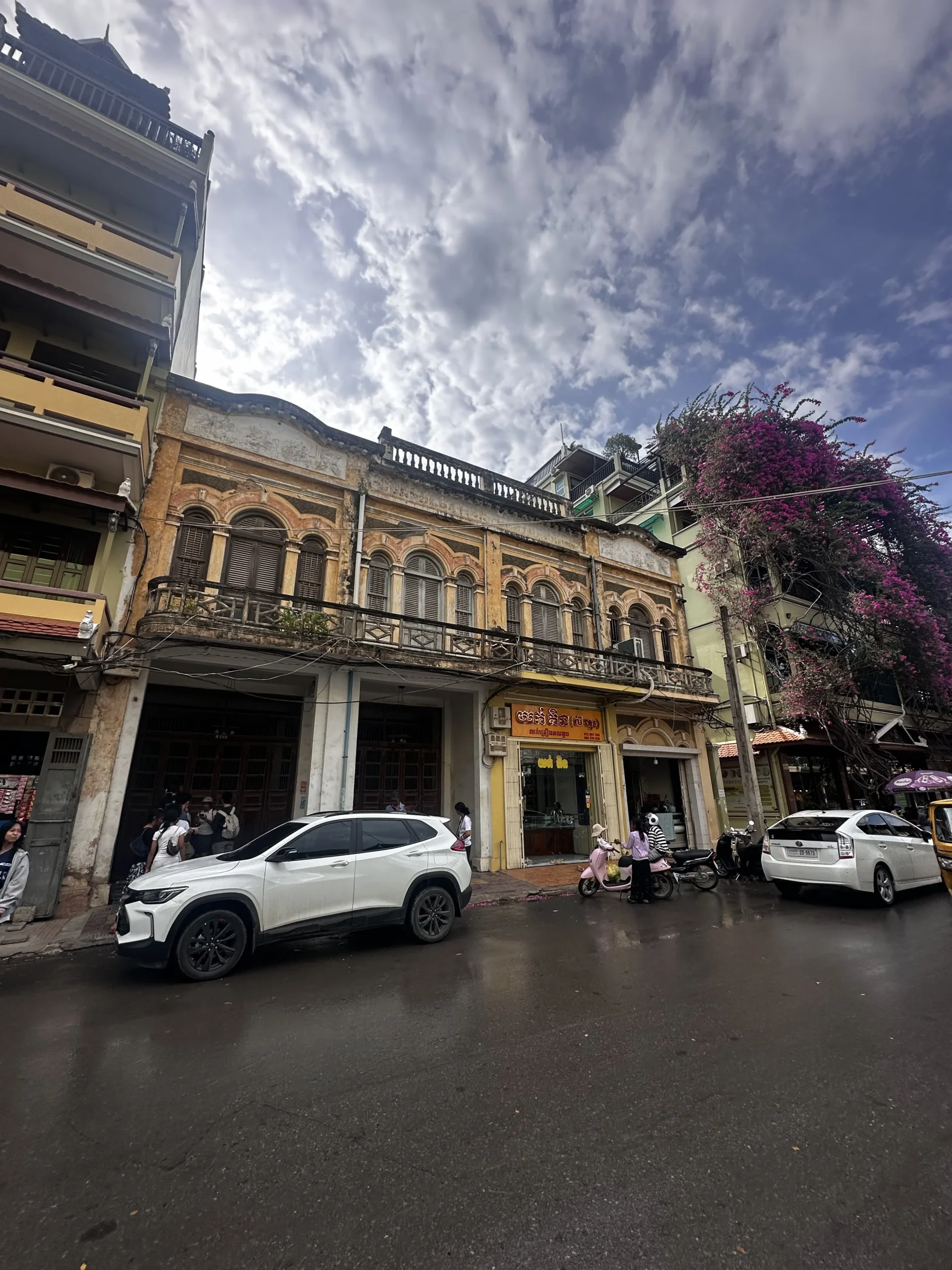
The central district in downtown Battambang is home to more than 800 historically relevant buildings. These primarily
come from two distinct eras - the early 1900s when the city was a French protectorate, and the Sangkum period in the
1950s-60s after Cambodia’s independence. There are other notable buildings and pagodas outside the main downtown
area that contribute to the heritage of the city.
We spent the first few days in the classroom trying to figure out where to start. There wasn’t much easy-to-find, reputable information available about the subject. While I had been to Battambang a few times before and appreciated the preservation of buildings in the city, I had no background in architecture, and only a basic understanding of the city’s history. While this may seem curious – why would I have been chosen for this project? – this isn’t a bug of the Liger educational model, it’s a feature. As Learning Facilitators, we are meant to help guide the student learning as we explore these topics, and in the process, upskill ourselves on the issues.
With the start of a basic understanding of the story, students then developed the Essential Questions of our Exploration to guide our research and conversations with experts.
- How can we inspire interest in and appreciation of Battambang’s historical architecture?
- How can we create a sustainable, lasting impact on people about Battambang’s history and heritage?
- How can we encourage the preservation of Battambang’s historical buildings?
- How can we design a product that spreads awareness about the historical heritage of Battambang?
From Research to Relationships
By the end of week three, students had contacted more than 14 different possible collaborative partners, including Phnom Penh architecture tour guides, prominent Battambang NGOs and businesses, partners Liger has worked with before, local government officials, the Vann Molyvann Project, and even Battambang Governor Sok Lou. They had also found additional resources, including a series of stories published by Kambujaya, which told the history of Shophouses, Khmer Housing and New Khmer Architecture. Groups of students read one of the stories and then presented their topic to the class, giving everyone a basic sense of Cambodian architecture within its historical timeline.
As they built this network of collaborators and knowledge, they inevitably hit bumps in the road. Some initial partnerships were no longer relevant to what we were doing. Other resources we wanted were either no longer available in
Phnom Penh, or prohibitively expensive as whole class experiences. Although a few contacts were unresponsive, what students found, overwhelmingly, was how much people wanted to help. The contacts seemed to find it difficult to
believe that this group of teenagers was genuinely interested in historical Battambang buildings and that they had a vision to actually spread awareness of the unique heritage of the town.
From the Classroom to Battambang
As we came to the fourth week of our project, it was time to finally visit Battambang. Our itinerary - structured,
comprehensive, and completely student-planned - called for us to complete the GIZ Central and South Walking Tours the
first afternoon we were in town.
We set off around 1:30 pm, and our first stop was Battambang's best cafe, Kinyei, housed in an old building on Street 1 1⁄2.
As we were leaving, we came across a group of Japanese college students. While everyone was still settling in - our trip
was really just starting and we didn’t know what to expect - one student got up the courage to introduce himself to one of
the Japanese students, as we wanted to learn more about what tourists knew or wanted to know about the architectural
history of the city. It proved to be an auspicious start, as they were in town on a similar mission to ours, to learn about the
preservation of historic buildings.
With one solid connection already made, we began the Central Walking Tour a few blocks away at Wat Pipetharam. The
sun was high in the sky, and we stood awkwardly around the pagoda grounds, sweating and watching someone toss
coconuts down from the top of a tree nearly as tall as the pagoda itself. We split up - one group walked towards the pagoda
while the other went towards the monks’ quarters. Everyone was hoping to find someone to speak with, at the same time
we anticipated leaving with nothing more than what we read on the tour map. Before long, we had found someone to show
us around a bit and provide a basic description of some of what made the pagoda unique. The other group had already met
the Chief Monk who was preparing to give us a personal tour of the entire pagoda - even telling us the story of the
distinctive columns and paintings in the interior.
Nearly an hour later, we left. We had gotten far more information than we could have ever imagined (the start of a theme
that continued throughout the trip), and the Chief Monk would have been happy to share even more if we had had more
time. But with more than 30 locations to see on our itinerary, we had to keep moving.
We didn’t spend an hour at each location on the map - we would probably still be there if we had - but every stop along the
path connected us with yet another helpful person. When people heard about what we were learning about (not even what
we hoped to do as a project), stories came pouring out. Locals were happy to show us around the inside of their homes.
Businesses let us explore their shops and back alleys. When we came across a location that was inaccessible, such as the
old cinema, neighbors helped connect us with local officials who might give us a tour of the inside. Security guards shared
stories and all the information they knew about other locations that were under renovation. There were truly no dead ends
- instead, just moments when we had to be a little more patient or use our ingenuity to find the way forward.
By the end of the first day, we had only visited half of the places we had hoped to see - the South Walking Tour would have
to wait. The students demonstrated another Liger Leadership Competency - Identification of Opportunities - and leaned
into maximizing their learning at the locations we visited, rather than trying to squeeze it all into just one day. The next
morning we had an even busier day, so we split into two groups, with half of the students going to the Ministry of Tourism
and the other half to Phare Punleu Selpak.
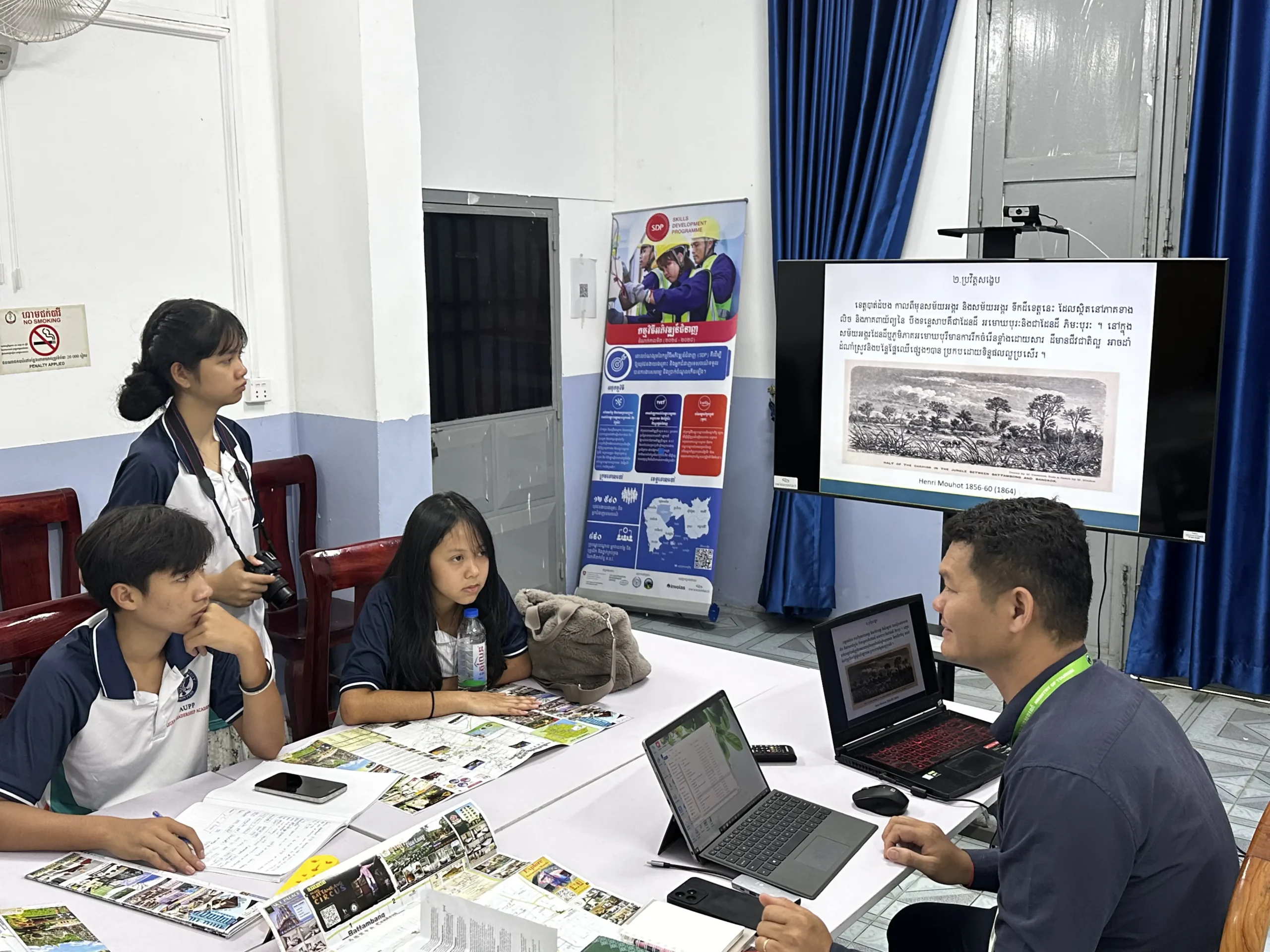
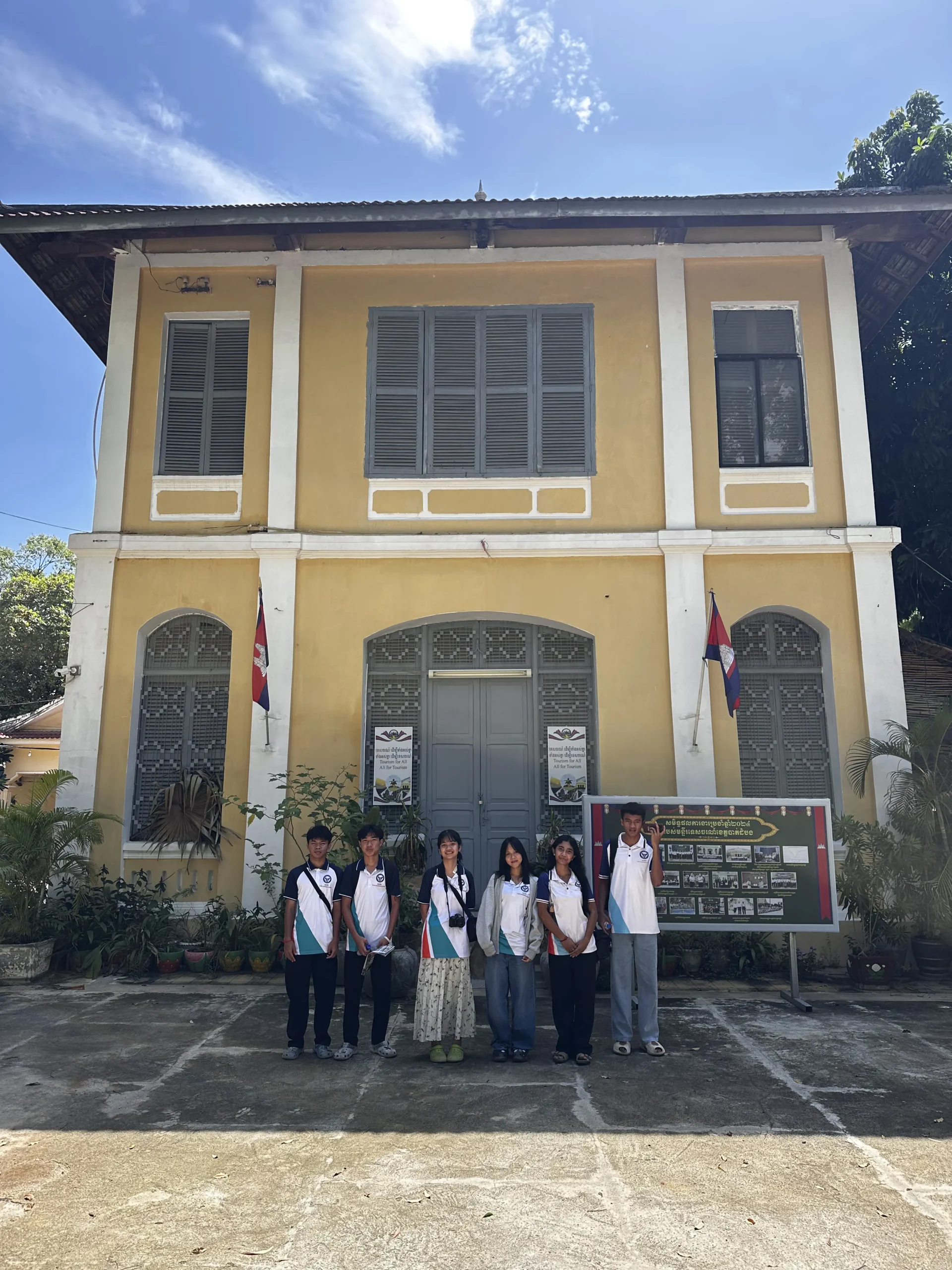
While the Ministry had initially asked us for an official letter from the school in order to meet, once we were in town, the students managed to get in the door without it. Not only were they happy to host us in their egg-yolk yellow, classic colonial villa, they even brought in a local architectural expert to help present the history of the city and its buildings. Our 30-minute meeting quickly hit the two-hour mark, as there was so much information to share and the students asked so many questions to get a better understanding of the history as well as up-to-date data related to tourism in the province. A few hours after we had left, the Ministry even shared this experience on their Facebook page, proud of the interest of the younger generation of Cambodians
In order to make up for our delays from the day before, our
group from the Ministry of Tourism explored the GIZ Southern
Walking Map after finishing. We ended up, serendipitously, inside the Royal Residence, as the Vann Molyvann bungalow
was listed on the map and the doors to the compound were open, with no one stopping us from entering. We walked past
the site of a former prison, now an ABA Bank. Other highlights included the Sala Khaet, which is now an Instagram-famous
building housing a museum of musical instruments and traditional Cambodian artifacts, and another smaller museum and
exhibition hall closer to town.
The other group visited Phare Punleu Selpak, Battambang’s longstanding creative arts and technical school, and origin of
their renowned circus, where they too wanted to get a better understanding of tourism and art in the city. Liger and Phare
have long been collaborative partners, sharing a vision of the value of education, the potential of young people and a love
of Cambodia. Liger students have interned with Phare before and worked with them on their year-long Grade 12 Impact
Projects. Liger students have created music videos with Phare artists and even made a documentary about the
organization’s founders and mission. Meeting with the Phare artists helped the students see the possibility of a
collaboration on possible products, as well as learn more about ways in which historical preservation is already taking
place in town through experiences like the Sa’art Street Festival.
That afternoon, we took another walk around the city, this time, with local expert tour guides from Soksabike. While they
were knowledgeable and provided a great deal of helpful information, what was so interesting for me was to see our kids
starting to feel a bit bored - not because of any fault of the guides, but purely because they were hearing information they
already knew from their own research, reading and work in the previous weeks. The tour - which in Week Two seemed like
the critical piece to our puzzle - actually did not give us much new information or insights. So much had changed in just
over a week.
At night we returned to Phare, this time as guests for their performance of Neang Neat, a comedy/horror circus show. I had seen several different Phare performances over the years, but I was particularly struck by how few tourists there were at this one. I noticed only one other foreigner amongst the crowd, whereas in years past, there were often nights that the show was sold out. The unanimous sentiment amongst the kids was that the Phare grounds were a magical place, not dissimilar to our old Liger campus. It could have been the trees, the grass, the buildings, but what I really think they felt was the spirit, energy, love, history and community of the place.
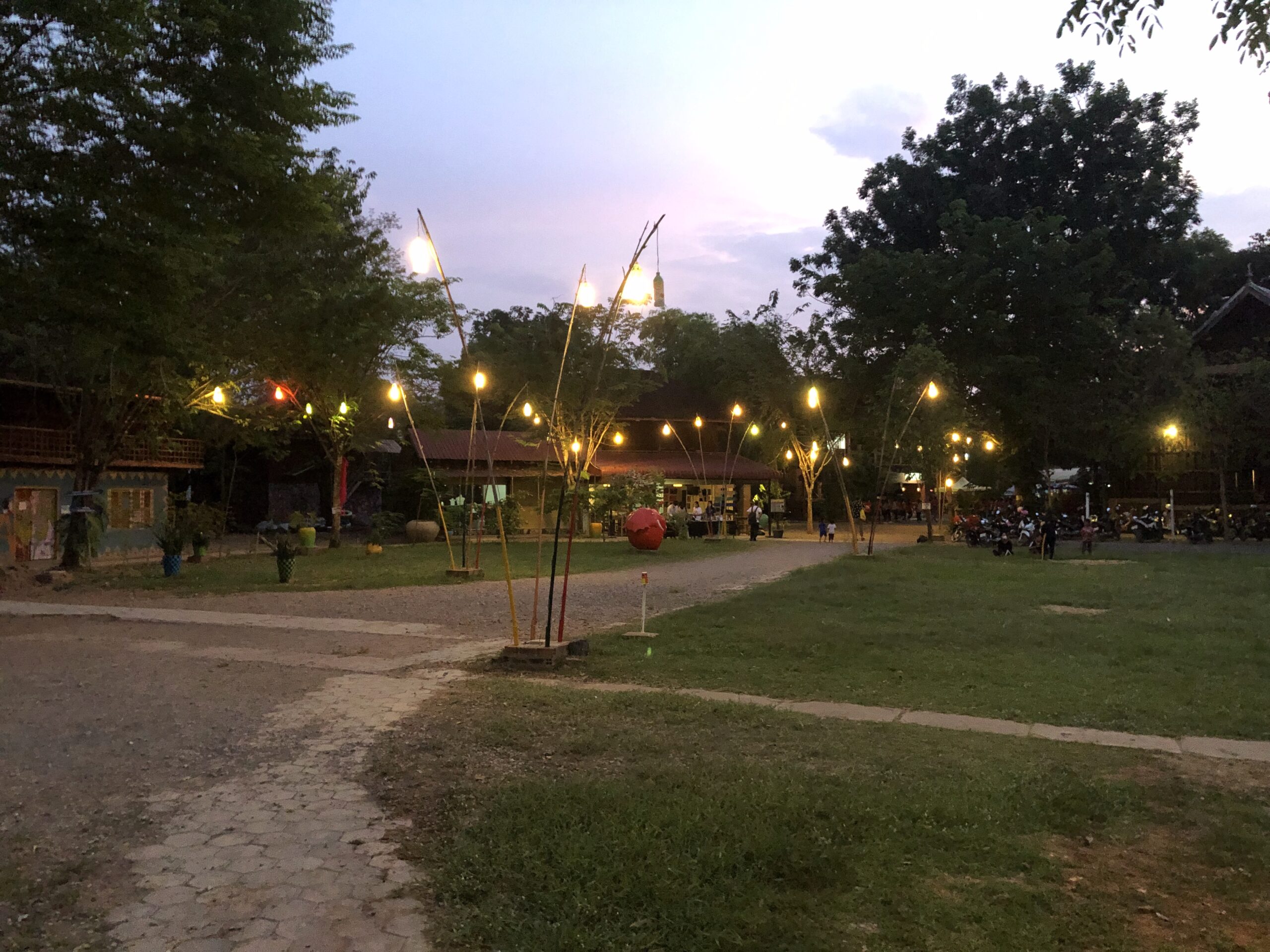
The connections grew from there. One last copy of Battambang Heritage, the book by Walter Koditek we had been desperately searching for during the past few weeks, was on sale. Phare performers asked us to say hello to Liger staff they had known for over a decade. Our relationships from the morning session were strengthened, and Phare volunteers, artists and performers encouraged us to share more about our project, as they wanted to collaborate with us if possible.
The “So What?” Moment
While all of this dot connecting, network building, problem solving and communication were commendable, at our
roundtable after the circus, I challenged the students with a question I often give them: So what?
Yes, they had had this experience. Yes, they had learned something interesting about these buildings. Yes, they cared. But
what were they going to do with what they learned? This moment was the true test of giving the students full agency of the
project, allowing them to make the consequential decisions about what we would do next. These decisions - good or bad -
would ultimately contribute to the project’s impact.
In our schedule, Friday was left open - no meetings, no tours, nothing. This wasn’t because we had nothing to do. Instead,
now that we had done our research, walked through the town and met with experts, we had to think about what we would
actually do next. The open-ended, truly student-led aspect of Explorations is the magic of the entire process.
We returned from breakfast at the city’s premier bai srop (rice and pork for just $1.50 a plate) spot and the students
immediately snapped right into collaboration-mode. I don’t think I’ll ever forget sitting in the downstairs of our guesthouse,
with the students in a circle, leaving them unencumbered by our presence to figure out the next steps.
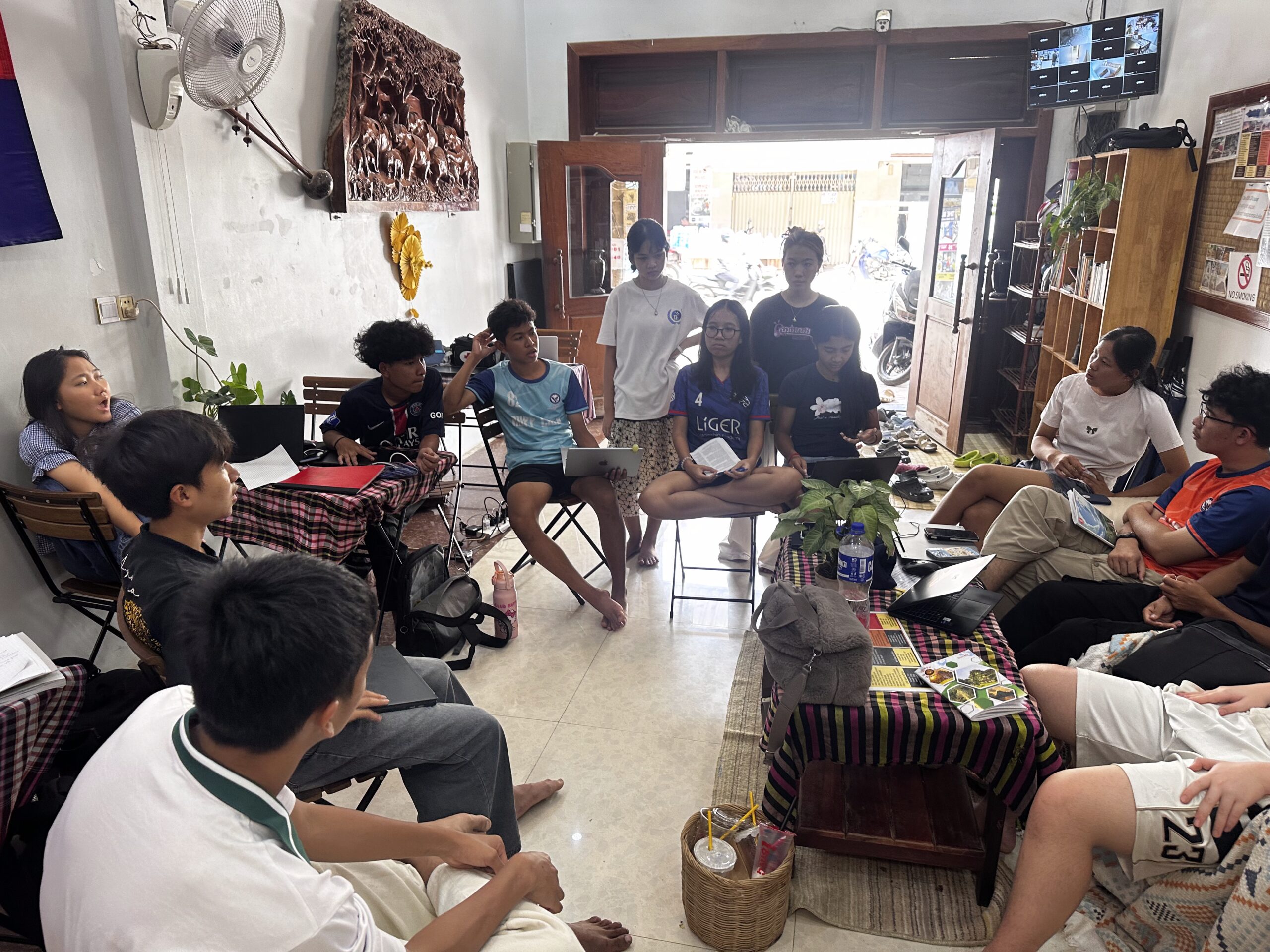
Marady, the other facilitator, and I sat aside on our computers, catching up on some work from school, while also trying to record some notes about how things had gone these past few days. Mid-Point Conferences, where the students receive feedback on the Core Value (Ingenuity) and Leadership Competencies (Vision and Influence, Problem Solving and Building/Maintaining Successful Networks) they have chosen as assessment goals for this project, would take place next week. We made notes of which students made great eye contact and asked questions during meetings, the student who said this Exploration gave him his passion, as well as a certain student who continued to push the group’s thinking each step of the way.
Those three hours were probably the best facilitation I’ve ever
been a part of, and to be honest, all I did that morning was
observe. This was authentic student ownership of their
learning. They took their own idea for a class, did their own
research, planned every moment and detail of this trip, and now they were deciding what to do with what they learned.
Which buildings were we going to return to? Who was going to be responsible for documenting each one? Once we had
enough videos/photos, what would we do with them?
What products would we make? What did we still need to know? Who else did we need to contact or connect with?
Discussing, developing and deciding these ideas together with their peers - what better way to learn in today’s world?
After decisions had been made and final tasks allocated, the groups split up for
the last time that afternoon, with each going to certain locations to conduct
final interviews, take photos and videos, and consider the story to tell from each
of the historical buildings they chose. A chance conversation at Kinyei the day
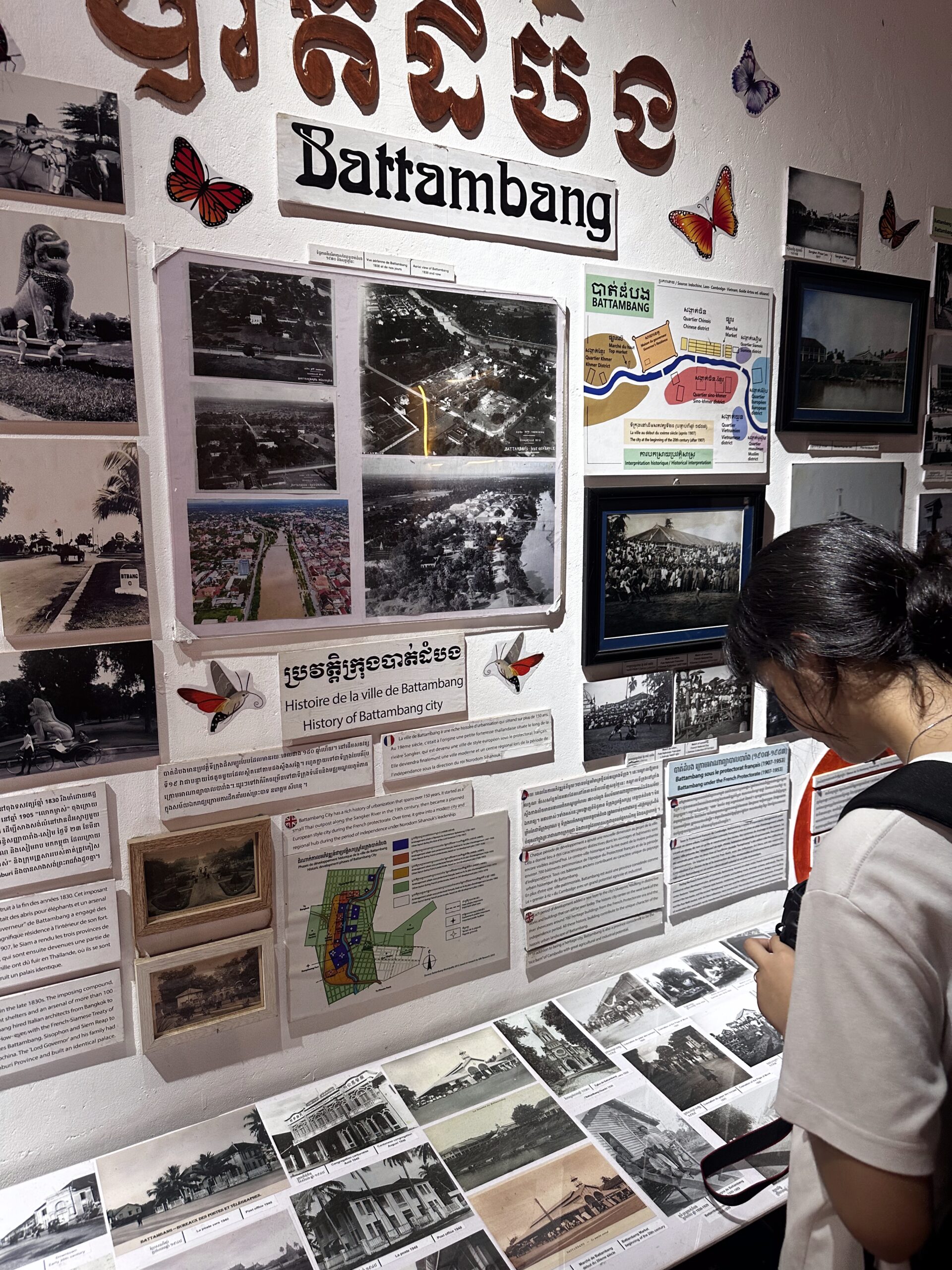
before led us to a place called the KC Museum, an invaluable collection of
Battambang artifacts organized and maintained by a longtime Battambang
expat named Jeremy. There we found additional resources - books titled Around
Battambang and Battambang During the Time of the Lord Governor- that would
further deepen our understanding of the city’s history and heritage in the
coming weeks. We viewed dozens of photos, drawings, maps and timelines
directly connected to our project.
After photographing a few other locations, our walk led us back to the very first
place we had been hoping to see, the abandoned cinema.
While neighbors had been helpful that first day, it wasn’t until earlier on the final
morning that we were finally granted access and a tour. Our guesthouse owners
overheard what we had been talking about, and they immediately put us in touch
with a contact of theirs who then connected us to someone at the Department of Fine Arts. While we waited in a hallway next to the cinema for a few minutes, our guide and his partner arrived right on
time at 2:30 pm to show us around.
Students took notes and photos as the guide led us through the dusty, empty building with his flashlight. We learned that although the cinema last showed a film in 2016, there was nothing stopping it from reopening other than the fact that no one had yet shared interest in investing in the place. While it had been refurbished and used in the 1980s-90s, I couldn’t help but feel like we were traveling back in time to the Sangkum period of Sihanouk in the 1960s, when Cambodian arts, music, culture and architecture were the jewel of the region.
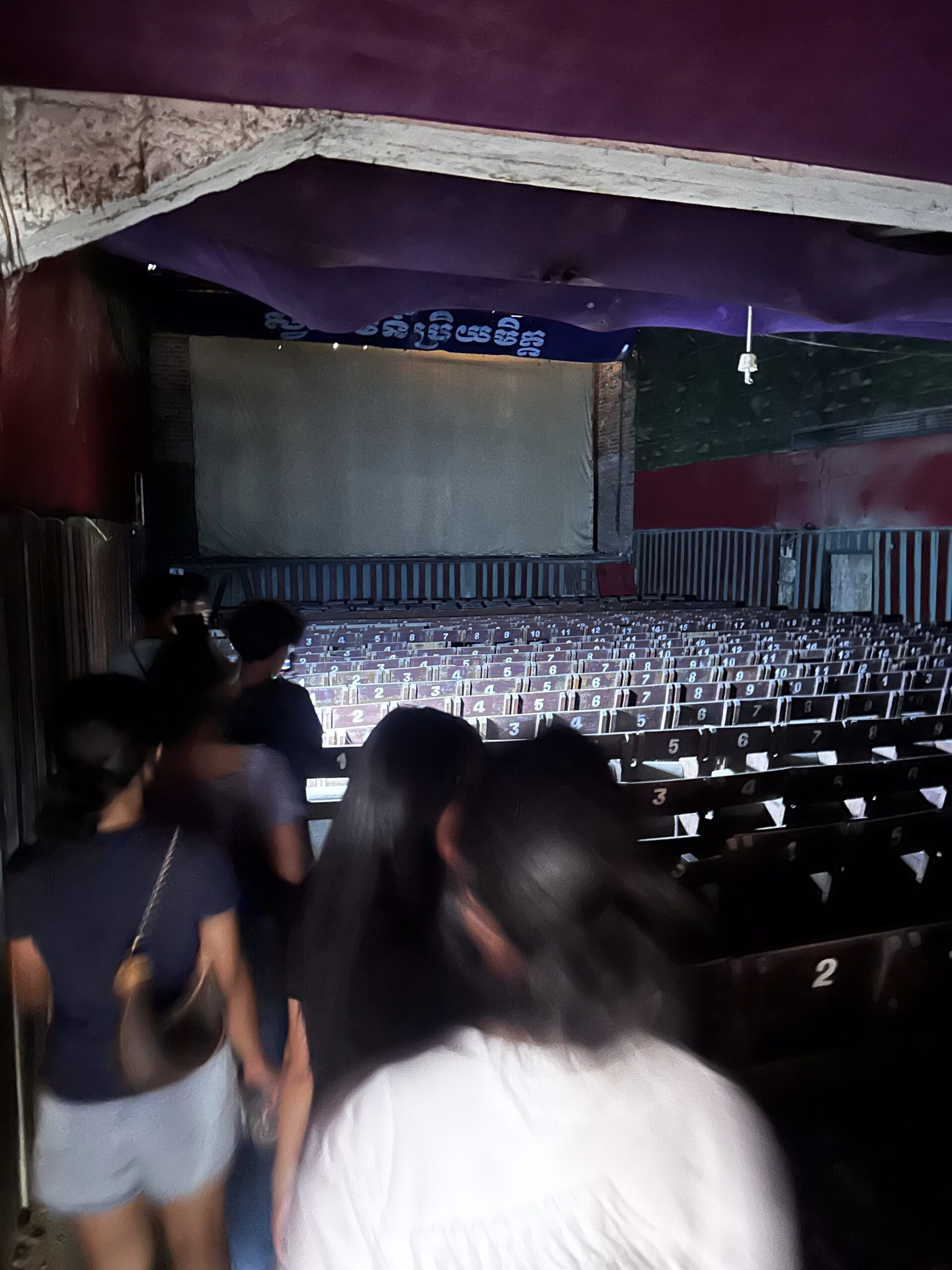
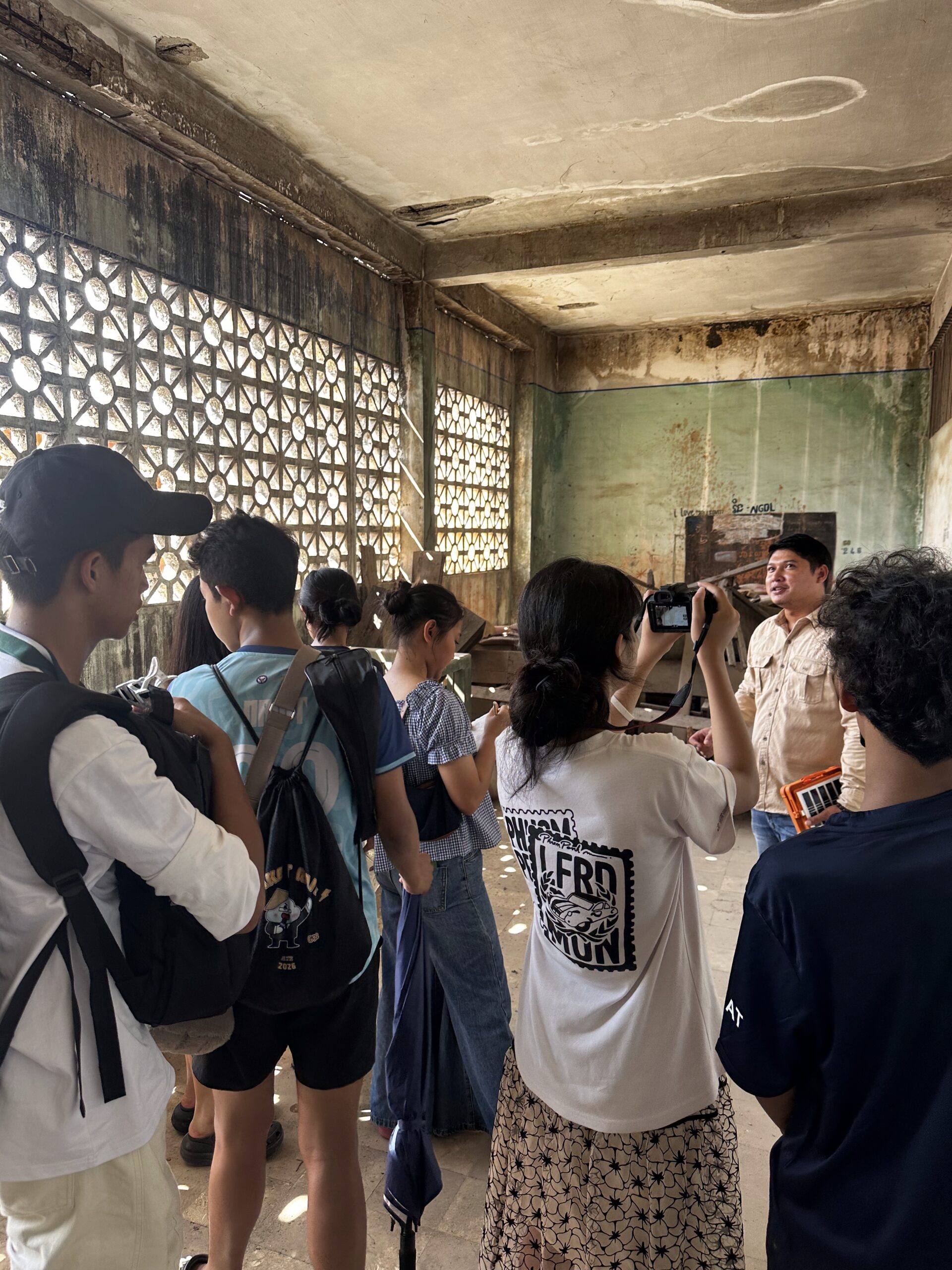
Our tour guide led us up through the upper floors of the
building where we saw the balcony section and
projector room. We eventually made it up to the
rooftop - not many buildings in this part of town are
higher than two stories - and the students’ questions
kept coming despite standing out under the midday
sun.
As we made our way back down to the ground floor, we
all realized we had been given a special gift - a piece of
the past - and wanted to be able to share that with
others as well as we possibly could.
The rest of our afternoon walk took us back through
the vine-covered abandoned Vice-Governor’s mansion,
and even back to the Royal Residence (though this time
we stayed behind the fence).
All week, one thing led naturally to the next, and though none of it had been planned, per se, it couldn’t have been planned
any better
From Learning to Impact
We are still in the middle of the project, with a few weeks left to go. Based on their conversations with experts and through
their own experiences, students have decided to make an updated version of the GIZ Walking Map, complete with QR
codes that link to videos telling more about the history of these buildings. Rather than being text-heavy, the map and
videos will be more visually appealing to modern audiences. Their ingenuity - how they design the videos and put them out
into the world - will ultimately decide how impactful this project ends up being. Will it merely be a class project, or
something that will live on sustainably in Battambang’s downtown tourist area?
While I don’t know where we will be by Week Nine, I feel a lot like I did that Friday morning in the guesthouse - this is right
where we should be, and exactly what learning should look like in today’s world.
Jeff Kane is a Learning Facilitator at AUPP Liger Leadership Academy.